• A new Bitcoin-themed bar in Washington, D.C., represents a striking intersection between digital finance and everyday social life, translating a once-niche technology into something as familiar as an evening out for drinks. Situated in the heart of the capital, the venue is designed not only as a nightlife destination but also as a meeting point for Bitcoin enthusiasts, policy thinkers, and the merely curious, all drawn together by a shared interest in how money and technology are changing. By embedding Bitcoin into a casual, approachable environment, the bar lowers the psychological barrier for people who have “heard about crypto” but have never interacted with it directly, turning abstract headlines into concrete experiences.

    At its core, the bar functions like a traditional establishment: guests can order cocktails, beer, and bar food, gather for trivia or live events, and enjoy the convivial atmosphere typical of a city pub. The difference lies in the infrastructure behind the experience, as the bar prominently supports Bitcoin payments alongside conventional options, allowing patrons to settle their tabs with a quick scan of a QR code connected to a digital wallet. This coexistence of cash, cards, and Bitcoin demonstrates how digital currency can operate within existing payment systems rather than attempting to replace them overnight, offering a living example of gradual financial innovation.

    Beyond serving drinks, the Bitcoin bar is built as a hub of resources that blend hospitality with education and advocacy. Many such venues include podcast studios, event stages, and dedicated spaces for think tanks and policy groups, turning the bar into a multipurpose center where discussions about regulation, technology, and economic freedom unfold in a relaxed, approachable setting. Public programming—such as weekly talks, workshops, and “Bitcoin 101” sessions—provides newcomers with structured opportunities to learn how Bitcoin works, how wallets are set up, and what risks and responsibilities come with holding digital assets.

    These resources translate into a wide range of uses for different communities across Washington. For developers and entrepreneurs, the bar offers networking events, panel discussions, and informal meetups where ideas for new applications, businesses, and policy proposals can be tested and refined. For policymakers, staffers, and advocates operating just blocks away from major federal institutions, the venue offers a neutral, social space to encounter real users of Bitcoin and observe how the technology is actually being used rather than discussed in the abstract.

    Ultimately, the opening of a Bitcoin bar in the nation’s capital symbolizes the institutionalization of digital currency culture, signaling that Bitcoin is no longer confined to online forums or speculative trading platforms. By combining entertainment, education, and political conversation under one roof, the bar becomes both a cultural landmark and a practical laboratory for understanding how decentralized technologies might reshape payments, savings, and governance. In this way, the Washington, D.C. Bitcoin bar stands as a tangible reminder that debates about the future of money are not only happening in hearing rooms and boardrooms, but also across bar counters, one transaction at a time.

    These are opinions and don’t represent HearsayOnlineCo ©️©️™️ and its subsidiaries

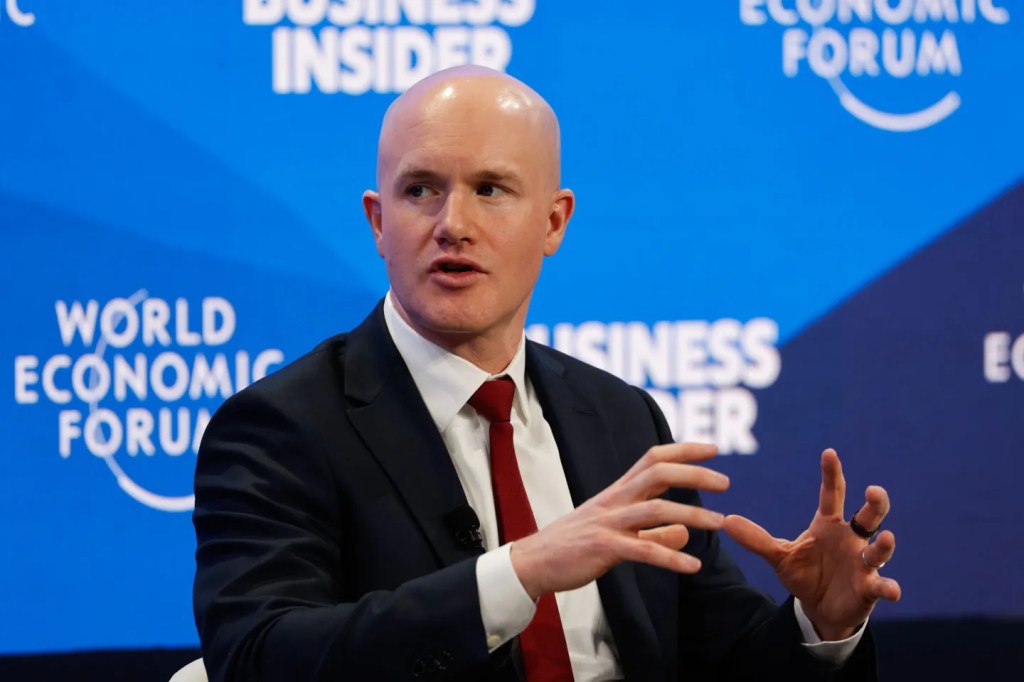
  • Coinbase CEO Brian Armstrong used the World Economic Forum in Davos this week to launch an unusually direct challenge to top French monetary officials, sharpening a broader global debate over who should control the future of money. In a series of high‑profile panels and interviews, Armstrong cast Bitcoin and crypto as a counterweight to central banks, arguing that citizens deserve alternatives to state‑managed currencies. The clash brought long‑simmering tensions between the crypto industry and European policymakers into the open, giving Davos a more confrontational tone than in previous years.

    The flashpoint came during a panel on tokenization, where Armstrong publicly corrected Banque de France governor François Villeroy de Galhau after the French central banker described Bitcoin as relying on “private issuers.” Armstrong responded that Bitcoin is a protocol with no single issuer and that its decentralized structure makes it “more independent” than any central bank, because no government, company, or individual can control it. Villeroy countered that democratic mandates and institutional accountability make central banks more trustworthy than unregulated monetary systems, underscoring Europe’s preference for state‑backed digital currencies over open crypto networks.

    Armstrong used the exchange to promote what he framed as “healthy competition” between Bitcoin and government money, insisting that people should be free to decide which system they trust more. He highlighted Bitcoin’s fixed supply and lack of a “money printer,” arguing that it offers a form of discipline on government spending at a time of rising concern over debt and inflation. The comments resonated with some Davos attendees who see crypto as a hedge against traditional finance, while alarming officials who fear that large‑scale shifts into private digital assets could weaken monetary sovereignty.

    Beyond the stage confrontation, Armstrong spent the week lobbying global leaders on U.S. crypto market‑structure legislation and the role of stablecoins, accusing traditional banks of trying to use regulation to stifle new competitors. He argued that properly regulated stablecoins should be allowed to pay interest, warning that banning yields on U.S.‑regulated tokens would simply push innovation offshore to more permissive jurisdictions. French officials, backed by some European bankers, pushed back that interest‑bearing private tokens could destabilize deposits and undermine the core funding model of commercial banks.

    The Davos confrontation between Coinbase’s chief and French leaders signaled a turning point in how the cryptocurrency question is handled in elite policy circles. Bitcoin itself, long sidelined in favor of discussions about blockchain infrastructure and central bank digital currencies, moved to the center of the conversation as a direct challenger to the existing monetary order. With U.S. regulators reworking crypto rules and European authorities advancing stringent frameworks of their own, this week’s clash in the Swiss Alps previewed a deeper political struggle over who will set the rules of digital finance in the years ahead.

    These are opinions and don’t represent HearsayOnlineCo ©️©️™️ and its subsidiaries

  • Minorities in Bitcoin Businesses and the Legacy of Dr. Martin Luther King Jr.

    As the digital economy continues to evolve, Bitcoin and blockchain technology have emerged as transformative forces reshaping finance, entrepreneurship, and global access to wealth. Yet, just as with previous economic revolutions, questions of inclusion and representation remain at the forefront. Minority participation in Bitcoin-related businesses—both as entrepreneurs and investors—has become an essential point of discussion, not only for financial empowerment but also for advancing the equality Dr. Martin Luther King Jr. envisioned for all people.

    Historically, minority communities have faced structural barriers to economic opportunity, from banking discrimination to limited access to capital. Bitcoin offers an alternative financial framework—one that operates outside traditional institutions and promises greater autonomy. Many Black and Latino innovators have embraced this technology, founding crypto startups, educational platforms, and blockchain-based solutions tailored to underserved communities. Through these ventures, they are not only claiming a voice in the digital economy but also challenging the inequities that persist in finance.

    Still, representation in Bitcoin businesses remains uneven. High barriers to entry, lack of technical education, and uneven distribution of venture capital continue to limit widespread minority participation. Addressing these disparities requires intentional inclusion—mentorship programs, accessible education, and equitable investment strategies. Doing so ensures that the benefits of Bitcoin’s decentralization are not confined to an exclusive few but shared broadly across diverse communities.

    Dr. Martin Luther King Jr. taught that social progress is inseparable from economic justice. His advocacy for empowerment, fairness, and unity remains profoundly relevant as the world shifts toward digital economies. In many ways, the struggle for equality in emerging technologies mirrors the civil rights battles of the past—both seek to dismantle systems that marginalize and open new pathways to freedom and opportunity.

    As we honor Dr. King on this day, we are reminded that true innovation must also be just. The dream he spoke of extends beyond racial harmony; it is a vision of empowerment through inclusion and shared prosperity. Minority participation in Bitcoin businesses not only honors that legacy but also moves us closer to a future where economic power reflects the diversity and unity of humanity itself.

    These are opinions and don’t represent HearsayOnlineCo ©️©️™️ and its subsidiaries

  • Bitcoin is a decentralized digital currency that enables peer-to-peer transactions without intermediaries like banks or governments. Introduced in 2008 by an anonymous creator known as Satoshi Nakamoto, it operates on a technology called blockchain, which serves as a public, tamper-resistant ledger recording all transactions. For novices, think of Bitcoin as digital cash you can send directly to anyone worldwide, secured by cryptography rather than trust in a central authority.​

    The core innovation of Bitcoin lies in its blockchain, a chain of blocks where each block contains verified transactions timestamped and linked to the previous one. This structure ensures transparency, as anyone can view the ledger, while cryptography protects privacy through public and private keys—public keys act like account numbers, and private keys sign off on spending. Miners, using powerful computers, validate transactions by solving complex puzzles, adding blocks to the chain roughly every 10 minutes and earning new bitcoins as rewards.​

    Bitcoin’s supply is capped at 21 million coins, making it inherently scarce, unlike fiat currencies subject to inflation from central banks. New bitcoins enter circulation via mining, but the reward halves approximately every four years in an event called the “halving,” slowing issuance until around 2140. This design mimics gold’s scarcity, positioning Bitcoin as a potential “digital gold” for storing value amid economic uncertainty.​

    To use Bitcoin, individuals need a wallet—software or hardware storing keys—to receive, send, or hold it. Transactions are broadcast to the network, verified by miners, and confirmed in blocks; fees incentivize faster processing during congestion. Exchanges like those allowing fiat-to-Bitcoin trades provide entry points, but users must guard private keys, as losing them means permanent loss of funds—no bank can recover them.​

    While Bitcoin offers financial sovereignty and low-cost global transfers, it faces challenges like price volatility, energy-intensive mining, and regulatory scrutiny. Its volatility stems from speculation and adoption cycles, yet growing institutional interest signals maturation. Novices should start small, research securely, and view it as a long-term experiment in money’s evolution.

  • Turkmenistan’s decision to legalize bitcoin and other cryptocurrencies in 2026 marks a striking break from its long-standing reputation as one of the world’s most closed and tightly controlled economies. By bringing digital assets under a formal legal framework, the government is attempting to balance its tradition of centralized authority with the desire to attract new investment and modernize its financial system. This policy shift reflects both domestic pressures to diversify an economy heavily dependent on natural gas and a broader global trend toward regulating rather than banning crypto assets.

    At the core of the 2026 reform is a “Law on Virtual Assets” that legalizes cryptocurrency trading and mining under strict state oversight, rather than granting bitcoin the status of legal tender. The law defines virtual assets as property or investment instruments, explicitly stating that they cannot be used as an official means of payment inside Turkmenistan. By allowing ownership, trading, and mining while blocking their direct use in everyday commerce, the government creates a controlled corridor for capital flows without surrendering monetary sovereignty over the national currency, the manat.

    Economically, legalizing bitcoin-related activity is framed as a tool to diversify revenue and exploit Turkmenistan’s exceptionally low electricity costs, particularly attractive for energy-intensive mining operations. Licensed crypto mines and exchanges are expected to draw foreign capital and technical expertise, supporting broader aims of digitalization and reducing dependence on gas exports alone. Yet this opening comes with heavy compliance burdens—registration, technical standards, and reporting requirements—that may filter out all but the most well-capitalized and compliant operators.

    The legal framework also embeds robust controls intended to limit financial crime and maintain political oversight over bitcoin and related assets. Exchanges and custodial services must obtain licenses from the central bank, enforce strict know-your-customer and anti–money laundering procedures, and keep most client assets in cold storage. Anonymous wallets and covert mining are banned, with authorities empowered to suspend licenses and shut down operations that violate regulations, reinforcing a model of state-managed, rather than permissionless, crypto adoption.

    Socially and politically, Turkmenistan’s bitcoin legalization unfolds in the context of pervasive internet censorship, limited access to foreign platforms, and an authoritarian governance structure that tightly monitors information flows. Even as the law opens a regulated channel for bitcoin and other digital assets, ordinary citizens may still face practical barriers in accessing global crypto markets due to infrastructure limits and surveillance. The 2026 reforms therefore symbolize a cautious experiment: embracing the economic upside of bitcoin within a walled garden of regulation, while preserving the state’s dominant role over both money and information.

    These are opinions and don’t represent HearsayOnlineCo ©️©️™️ and its subsidiaries

  • E & East Company, working in collaboration with HearsayOnlineCo, presents itself as a compact media outlet focused on promotional and informational content related to bitcoin and associated financial services. Its broadcasts, often distributed in short podcast or audio-ad formats, frame bitcoin not just as a speculative asset but as a gateway to innovative products such as bitcoin-backed loans and related credit offerings. Through this lens, the company blends advertising with education, inviting listeners to explore bitcoin’s role in emerging digital finance platforms.

    In its broadcasting about bitcoin, E & East Company typically emphasizes the practical uses of the cryptocurrency rather than the technical intricacies of the underlying blockchain. Episodes and short ads reference services like “Bitcoin Loans” and link to platforms such as bitcoinloans.credit, suggesting a focus on how bitcoin can function as collateral or as a bridge to alternative credit markets. This orientation situates the company’s content at the intersection of marketing and financial literacy, aiming to familiarize audiences with bitcoin as a usable financial instrument rather than a distant, purely speculative concept.

    The broader context for E & East Company’s work is bitcoin’s evolution into the first widely adopted cryptocurrency, used for secure peer-to-peer transactions and increasingly integrated into mainstream finance. Bitcoin operates on a decentralized network of nodes that maintain a public blockchain ledger, enabling users to transfer value without a central authority. In highlighting products like bitcoin loans, the company implicitly draws on these properties—security, openness, and global accessibility—to frame bitcoin as a foundation for new financial services and as an asset that can back real-world borrowing and lending activity.

    E & East Company’s collaboration with HearsayOnlineCo also reveals an attempt to build a small but engaged community of listeners around bitcoin-related themes. Dedicated feeds for “fans” and “followers” suggest that the broadcasts serve not only as advertisements but also as touchpoints for an audience interested in staying current with niche developments like bitcoin lending or bitcoin-focused news briefs. By maintaining these channels, the company encourages repeated exposure to bitcoin concepts, which can gradually normalize cryptocurrency use for everyday financial decisions.

    Ultimately, the broadcasting activities of E & East Company by HearsayOnlineCo contribute to the wider narrative of bitcoin as more than a volatile digital token. Through short, targeted pieces about bitcoin loans and related services, the company presents bitcoin as part of an emerging financial ecosystem in which digital assets play a role similar to traditional collateral or savings. In doing so, its content participates in the ongoing cultural shift that views bitcoin as a legitimate building block of future finance, even as debates about regulation, volatility, and long-term stability continue in the background.

     E & EAST COMPANY

    These are opinions and don’t represent HearsayOnlineCo ©️©️™️ and its subsidiaries

  • In a surprising twist blending the digital finance and entertainment sectors, major investors from the cryptocurrency firm Bitmine have announced a substantial investment in MrBeast’s growing enterprise. Jimmy Donaldson, known globally as MrBeast, has built an empire that extends far beyond YouTube, including food brands, tech ventures, and philanthropy. The partnership signifies a merger of next-generation media influence and the rapidly evolving blockchain economy, promising to reshape how digital entrepreneurs connect with online audiences and financial technology.

    Industry analysts describe the collaboration as a bold move that could signal a broader trend of crypto-based firms investing in creator-driven ventures. Bitmine, previously recognized for its expertise in crypto mining infrastructure and sustainable blockchain solutions, appears eager to diversify its portfolio. By aligning with MrBeast’s multifaceted brand, the company is leveraging his global reach and active fanbase—an audience that epitomizes digital-first consumers who readily engage with tech-forward ideas.

    Reports suggest that the new capital injection will support the expansion of MrBeast’s business initiatives, including his content production studio and social impact projects. Sources close to the deal highlight mutual interests in transparency and innovation, values both Bitmine and MrBeast emphasize. The partnership could accelerate efforts to create new platforms where fans can directly participate in projects through blockchain-driven systems, possibly including community tokens or philanthropic NFTs.

    Financial experts, however, caution that such collaborations must navigate the volatility of cryptocurrency markets. The success of this venture may hinge on consumer trust and the ability to bridge entertainment with responsible financial practices. For MrBeast, whose brand has long championed giving and social good, ensuring that these technologies remain ethical and accessible will be crucial to maintaining his positive reputation.

    As the digital economy continues to blur the lines between finance, entertainment, and community engagement, the Bitmine–MrBeast alliance stands out as a defining experiment. If successful, it could become a model for how content creators and crypto investors co-build the next generation of internet enterprises

    These are opinions and don’t represent HearsayOnlineCo ©️©️™️ and its subsidiaries

  • Bitcoin enters the new year trading near record territory, having reclaimed a strong upward trajectory after a volatile close to 2025 that saw the token slip from an autumn peak above 126,000 dollars to a late‑year range around 86,000 to 90,000 dollars. In early January 2026, the price’s surge back above 93,000 dollars has been interpreted by market analysts as confirmation that the asset remains in a broader bullish cycle rather than the start of a prolonged downturn. This rebound, coupled with persistent interest from institutional investors, frames bitcoin as one of the most closely watched risk assets heading into the new year.

    Over the past two years, bitcoin’s rise in valuation has been shaped by several structural milestones: the launch and rapid growth of spot bitcoin exchange‑traded funds in major markets, the latest block‑reward halving, and an increasingly supportive policy tone from governments that view digital assets as strategic reserves rather than fringe experiments. These developments have expanded access for pension funds, asset managers, and corporate treasuries, deepening liquidity and helping bitcoin stay above key long‑term moving averages even through sharp corrections. As a result, the token has evolved from a niche speculative play into a headlinemacro asset that reacts to interest‑rate expectations, regulatory shifts, and geopolitical tensions.

    Forecasts for the coming year remain strikingly optimistic, even as seasoned observers warn that volatility will continue to define the market. Major investment firms and crypto research houses project that bitcoin could trade in wide bands, with conservative outlooks placing average prices in the mid‑five‑figure range and more aggressive scenarios pointing to six‑figure targets that approach or surpass 150,000 to 200,000 dollars if institutional flows remain strong. Analysts point to bitcoin’s finite supply, growing recognition as “digital gold,” and the historical pattern of post‑halving bull markets as the key drivers behind these ambitious price targets.

    Yet alongside the bullish narrative, risk factors cast a long shadow over the new year’s outlook. Heightened geopolitical strains, potential delays in central‑bank rate cuts, and the possibility of fresh regulatory crackdowns on crypto trading platforms could all trigger sharp pullbacks, especially if broader equity markets also correct. Veteran strategists emphasize that while the presence of long‑term “dip buyers” and ETF‑driven demand may dampen the extreme 70–80 percent drawdowns seen in earlier cycles, double‑digit percentage swings within weeks—or even days—remain very much on the table.

    For now, sentiment into the new year tilts cautiously optimistic, with options markets showing renewed appetite for upside exposure and research desks flagging 100,000 dollars as the next psychologically important threshold for traders. Whether bitcoin can convert this technical momentum into a sustained rally will likely hinge on a delicate balance: supportive but not overheated liquidity conditions, clear and stable rules from regulators, and continued adoption by large institutions and even sovereign wealth funds. In the coming months, bitcoin’s performance will serve as a barometer not only for digital assets, but also for investor appetite for risk in an uncertain global economy.

    These are opinions and don’t represent HearsayOnlineCo ©️©️™️ and its subsidiaries

  • Bitcoin’s global network continues to function normally while Iran experiences a severe nationwide internet blackout that is disrupting local crypto usage and some mining activity, but not threatening Bitcoin’s overall operation. The situation is instead highlighting both Bitcoin’s resilience to regional shutdowns and the practical limits of using it under heavy censorship and connectivity cuts.

    Iran’s internet blackout

    • On 8 January 2026, Iran imposed a near‑total internet shutdown amid escalating anti‑government protests, cutting most of the country off from external communication. Monitoring groups report traffic dropping to around 1% of normal levels, affecting mobile and fixed‑line networks as well as many phone services. 
    • Authorities have also moved to jam satellite connectivity such as Starlink, producing estimated packet loss of 30–80% for users in some regions and further limiting digital communications. 

    Impact on Bitcoin use in Iran

    • The blackout has effectively blocked online transactions for millions of Iranian crypto users; one industry estimate puts the affected population at roughly 7 million people who rely on internet‑based wallets and exchanges. From January to July 2025, crypto transaction volume linked to Iran was about 3.7 billion dollars, underscoring how many economic activities are now constrained. 
    • With banking pressure and a weakening rial, many Iranians had turned to Bitcoin and other digital assets as a value store or for cross‑border transfers, but the current shutdown severely limits their ability to move funds or access centralized platforms in real time. 

    Effect on Iranian Bitcoin mining

    • Iran has been a low single‑digit contributor to global Bitcoin hashrate, down from much higher levels earlier in the decade due to crackdowns and regulatory swings. Cheap, subsidized energy made the country attractive for miners, but sanctions, raids, and periodic forced shutdowns have already pushed much of the activity underground or out of the country. 
    • The current connectivity crisis raises operational costs and downtime for miners in Iran—pool coordination, payouts, and firmware updates become harder—but analysts estimate that even a full Iranian outage would remove less than 5% of global hashrate, a level the network can absorb via difficulty adjustment without destabilization. 

    Bitcoin network resilience

    • Bitcoin is designed so that mining power is globally distributed; it survived China’s 2021 mining ban, which removed over 40% of hashrate at the time, without halting block production or invalidating funds. In comparison, Iran’s share today is much smaller, so its outage is structurally manageable for the protocol even if locally painful. 
    • When regional hashrate drops, the protocol’s difficulty retargeting gradually lowers the computational threshold needed to mine blocks, helping keep average block times near ten minutes and preserving the security and continuity of the chain. 

    Offline and censorship‑resistant Bitcoin tools

    • Iran’s shutdown has driven renewed interest in “offline‑first” or low‑connectivity Bitcoin tools such as SMS‑based services, mesh networks, and satellite relays (for example, solutions built on Blockstream’s satellite network), which can help users construct and relay transactions with minimal or intermittent internet. These systems still ultimately require some connection to reach the global network, but they can reduce dependency on local ISPs and state‑controlled infrastructure. 
    • Crypto industry reports mention platforms and protocols that try to bridge connectivity gaps—ranging from satellite‑fed nodes to specialized messaging apps for signing and forwarding transactions—as part of a broader push to keep Bitcoin usable in high‑censorship environments like Iran.

    These are opinions and don’t represent HearsayOnlineCo ©️©️™️ and its subsidiaries